

The business: who a fleet manager is, and why their decisions matter
In a large company, the fleet manager runs one of the biggest indirect costs on the books: the cars and vans that sales teams, technicians and managers use every day. The role sits between procurement, HR, finance and sustainability. A fleet manager writes the car policy that decides who gets which vehicle, negotiates multi-year contracts with leasing and rental companies, controls fuel, charging, maintenance, insurance and claims, and keeps the fleet compliant with tax and safety rules. Then they report to top management on what the fleet costs and where it should go next.
The scale is easy to underestimate. In Italy, long-term rental alone puts more than 1.3 million vehicles on the road, most of them for companies, in a sector worth over €13 billion a year. Rental accounted for roughly a quarter of all new cars registered in the country in 2025. The largest corporate fleets run to tens of thousands of vehicles. At an average annual rental fee of around €7,200 per company vehicle, a fleet of 20,000 represents a commitment in the order of €140 million a year, before fuel, energy and running costs.
That makes every renewal cycle a decision with consequences inside and outside the company. Inside, the car policy shapes the working day and the taxable benefit of thousands of employees. Outside, a single fleet tender can move thousands of orders between brands, powertrains and leasing companies at once. And the ground keeps shifting: fringe-benefit taxation changes how employees pay for their company cars, Euro 7 and CO₂ rules change which vehicles make sense, and proposed EU targets would require large companies to make a growing share of new company cars zero-emission over the next decade.
Fleet managers therefore need timely, reliable and expert-checked information they can act on and defend in front of the board. Providing that information is what a professional publisher in this sector does.
What the publisher built: a workspace for fleet decisions
The publisher's own team used an AI app-building tool, in this case Replit, to turn that need into a working application: the Fleet Workspace.
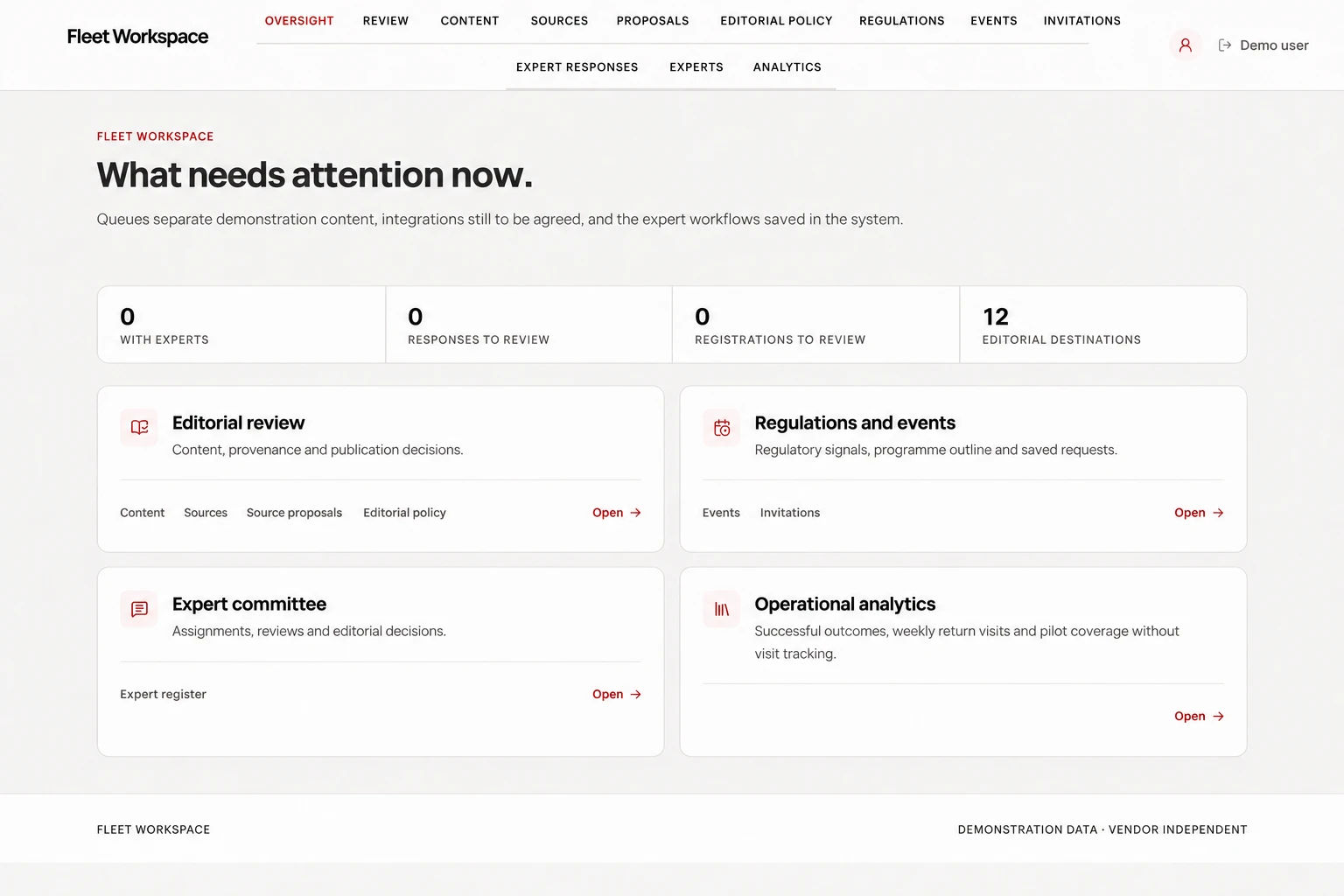
The prototype was designed around one operational objective: give fleet managers a single place to stay ahead of regulation and the market, and turn that knowledge into decisions they can justify. Its functional scope covered:
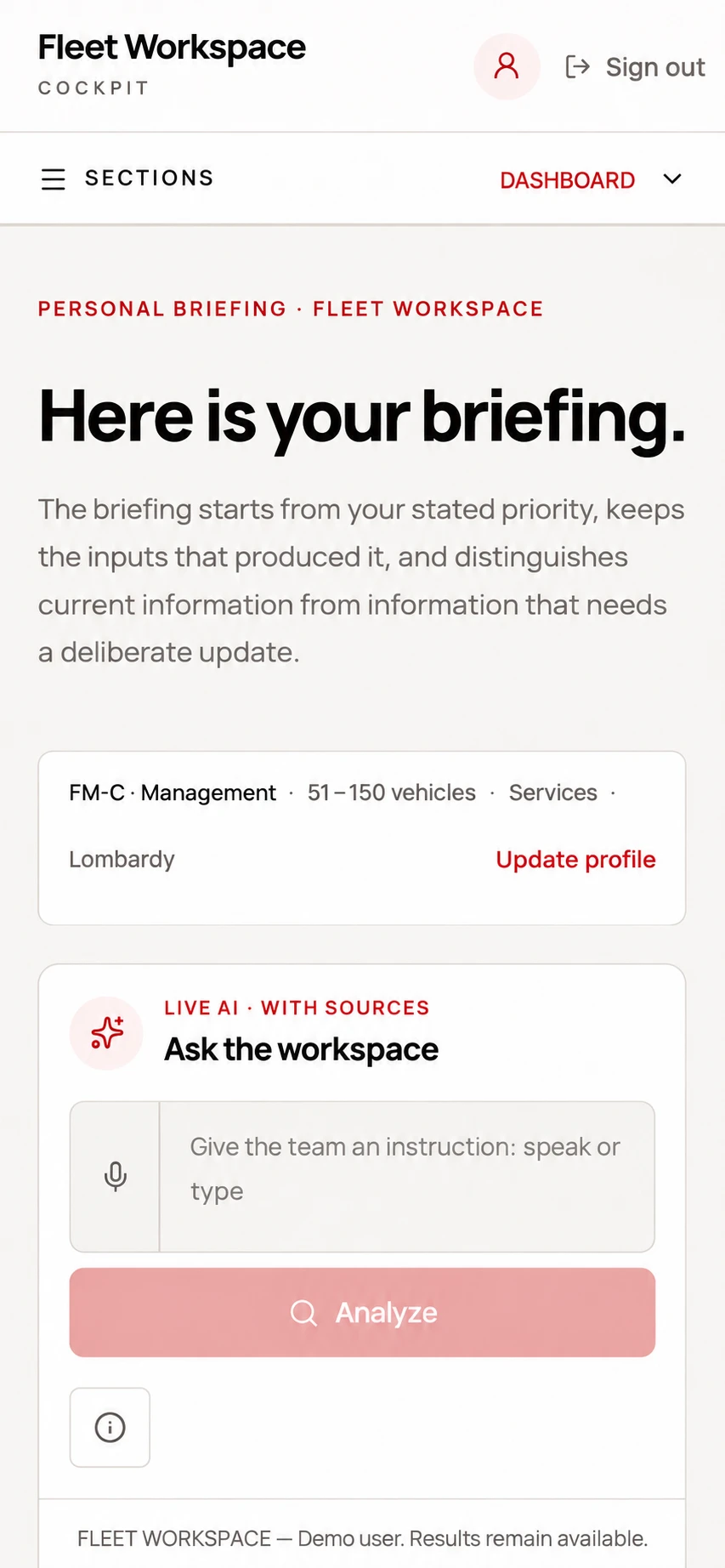
- Briefings that summarize what has changed for fleets and lead to the practical tools behind each topic.
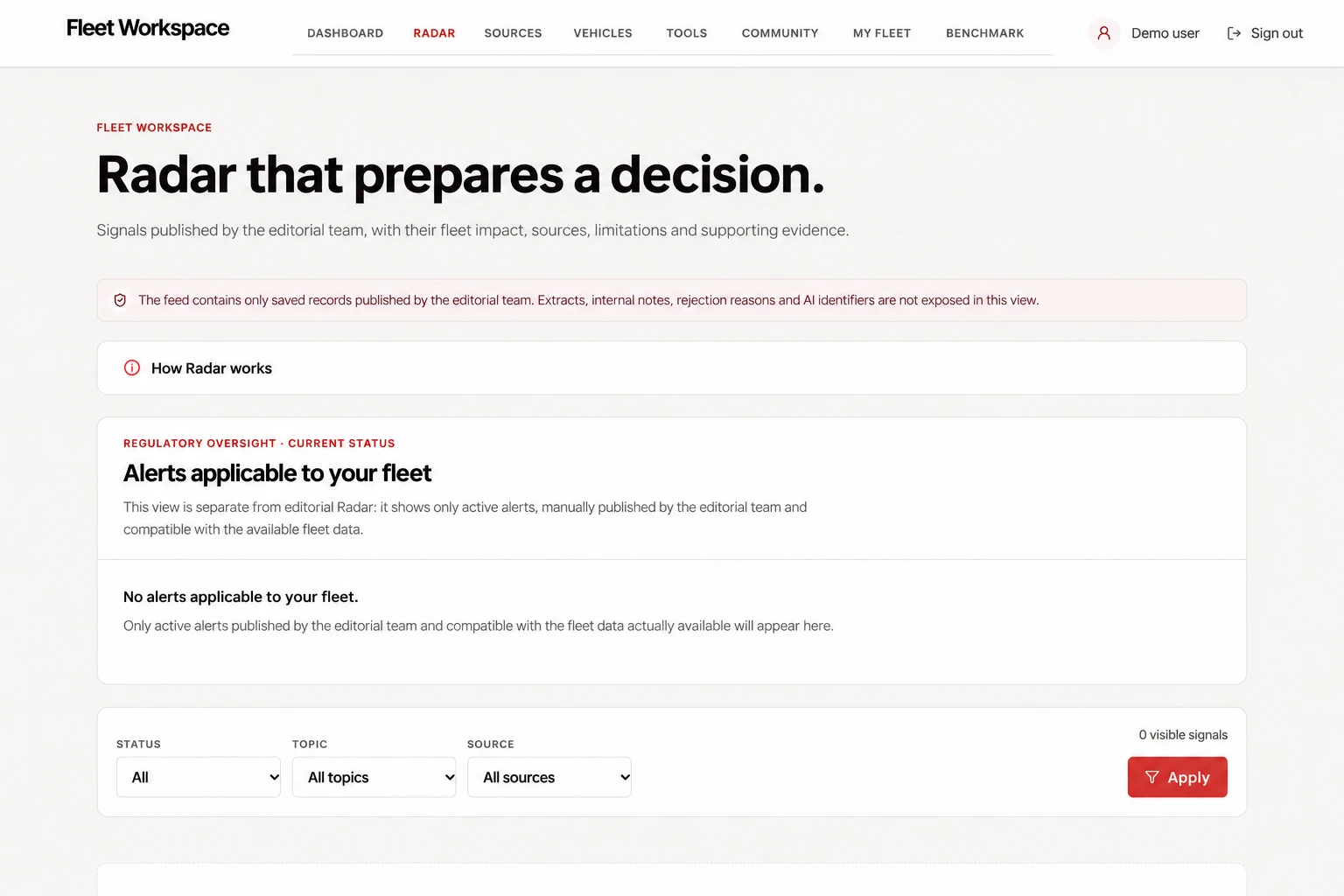
- Intelligence Radar, a regulatory-alert area that tells fleet managers which rules affect them, such as Euro 7 emission standards.
- Vehicle information and benchmark tools that support choices about models, powertrains and costs.
- Events and access to experts, so a fleet manager can take a specific question to a specialist.
- An editorial workspace where the publisher's editors select sources, review proposals and decide what is published.
- A mobile workspace with the fleet manager's profile and briefing, for the role's day on the road.
The business value view
| What a fleet manager has to do | What the Fleet Workspace provides | The value for the fleet manager's company |
|---|---|---|
| Keep the fleet compliant as tax, emission and EU rules change | Intelligence Radar alerts, prepared and approved by editors | Fewer surprises at renewal; decisions grounded in the rule as it stands |
| Choose vehicles and powertrains for the next renewal cycle | Vehicle information and benchmark tools | Comparable figures behind a choice worth millions a year |
| Report to top management and defend recommendations | Briefings from identified, editorially accepted sources | A traceable basis for every recommendation |
| Resolve questions that standard information doesn't cover | Access to experts and events | Specialist judgment available within the same workspace |
| Work away from the desk | The mobile workspace | The briefing and profile available on the move |
For the publisher, the same workspace turns its editorial expertise into a recurring professional service, not only articles and events.
Why a prototype built by the client changes the economics of delivery
Most software projects start from a specification gathered from outside: interviews, workshops and documents that a supplier interprets and the client approves page by page, often without seeing anything work.
This one started the other way round. The people who know fleet managers best had already designed the product, down to its screens, navigation and vocabulary, and had tested it inside their own organization. When the delivery work began, the specification was internally validated, accepted, and visible in a working application.
That changes the deal for both sides. A large share of the work that normally fills the first phases of a project (discovery, requirements and interface design) had already been done, and done by the people who will own the result. The publisher saw its own design carried into the service and kept full ownership of it. The delivery team could start from a product people had already agreed on and concentrate on the part a prototype cannot provide: running reliably, securely and accountably for paying professional customers.
What it took to bring the workspace into service
A prototype proves what a product should do. A professional service also has to prove it can be trusted, operated and changed. That second part is where the collaboration model is changing.
Three parties now share the work. The client brings the domain knowledge and a validated product. A delivery partner such as SmoothOperator.ai brings the operating layer and the engineering discipline to put it into service. Compute and model providers, including the major cloud and AI platforms, bring the capacity on which the service runs, chosen to fit the client's data and privacy requirements. Each does what it is best placed to do, and the client never hands its product over.
Our part followed the established path from build to service:
- Product baseline. The prototype was adopted as the reference for what each person should be able to do. Nothing the publisher had settled was redesigned.
- Production architecture. The application was rebuilt on its own production foundation, separate from the prototyping tool, with role-based access, persistent records and an editorial process the business can audit.
- Verification and acceptance. The rebuild was tested role by role, for fleet managers, editors and experts, on desktop and mobile, so the publisher could accept each step from the side of the person acting and the person relying on the result.
- Release readiness. The conditions for going live were made explicit: data rights, connections to the publisher's systems, user onboarding, service ownership and recovery.
The value delivered so far
The publisher kept its product. The Fleet Workspace looks and works as the publisher designed it. Its navigation, vocabulary and working methods carried into the rebuild unchanged.
Published information became a record, not a re-generation. When editors publish an alert, such as one on Euro 7 prepared with AI assistance, the approved text is stored and served as published. A fleet manager who returns to it later reads the words the editor approved, with the source behind it. For a reader who has to defend a decision to the board, that is the difference between information and a professional service.
Authority follows the role. Editors decide which sources enter the register and what is published. Experts contribute. Fleet managers act on the result. The application enforces those boundaries, so the editorial method that gives the publisher its credibility is built into the service.
The road to release is specific. Instead of a general question about whether the workspace is ready, the publisher now has a short list of decisions to take: which data it can offer customers, which distribution channels belong in the first release, how new fleet managers are onboarded, and who runs and recovers the service.
How the platform supports the service
| What the service needs | How the platform provides it | Platform component | Status in the Fleet Workspace |
|---|---|---|---|
| Published information stays as approved | AI-assisted output becomes a saved publication, kept with its evidence and retrieved as published | 3 · TruthFlow™ | Built: Radar alerts persist and reopen unchanged |
| Every item traces back to its source | Source documents are prepared for search and reference, starting from the sources the editors choose | 1 · DataStudio™ | Source register built; document preparation to follow |
| The editorial method is applied consistently | Proposing a source, accepting it and publishing an alert are distinct steps, each with its own responsibility | 2 · MetaBuilder™ | Steps distinct in the application |
| Each person acts within their role | Access controls define who may act at each step | Guardrails & Oversight | Built: three roles tested on desktop and mobile |
| Information reaches readers where they work | Integration boundaries define which systems take part and how | 5 · Integration layer | Inside the workspace; newsletter and customer-system connections to be built |
| Models and data run where the client needs them | Data location, inference and model access are agreed together, with Private AI™ when the material is sensitive | 4 · Private AI™ | To be agreed |
| The next service starts faster | New expert contributions or publication channels reuse the same foundation for sources, permissions and review | The platform | — |
The table describes what the rebuilt workspace does and the platform role behind each behavior. Connecting each platform module to the workspace is part of the integration work; we will present those connections as delivered once they have been demonstrated.
Why this matters
Business teams can now build working applications themselves with AI app-building tools, and the ones that know their market best will keep doing so. What they create is not a draft. It is a validated business case, expressed down to the screen, that the client already feels it owns.
That is the starting point SmoothOperator.ai is designed for. The client brings the product and the domain. We add the operating layer and the delivery discipline, and run it on the compute and models that fit the client's requirements. The client keeps ownership and moves faster, because the hardest part of any project, agreeing what to build, was settled before we arrived.